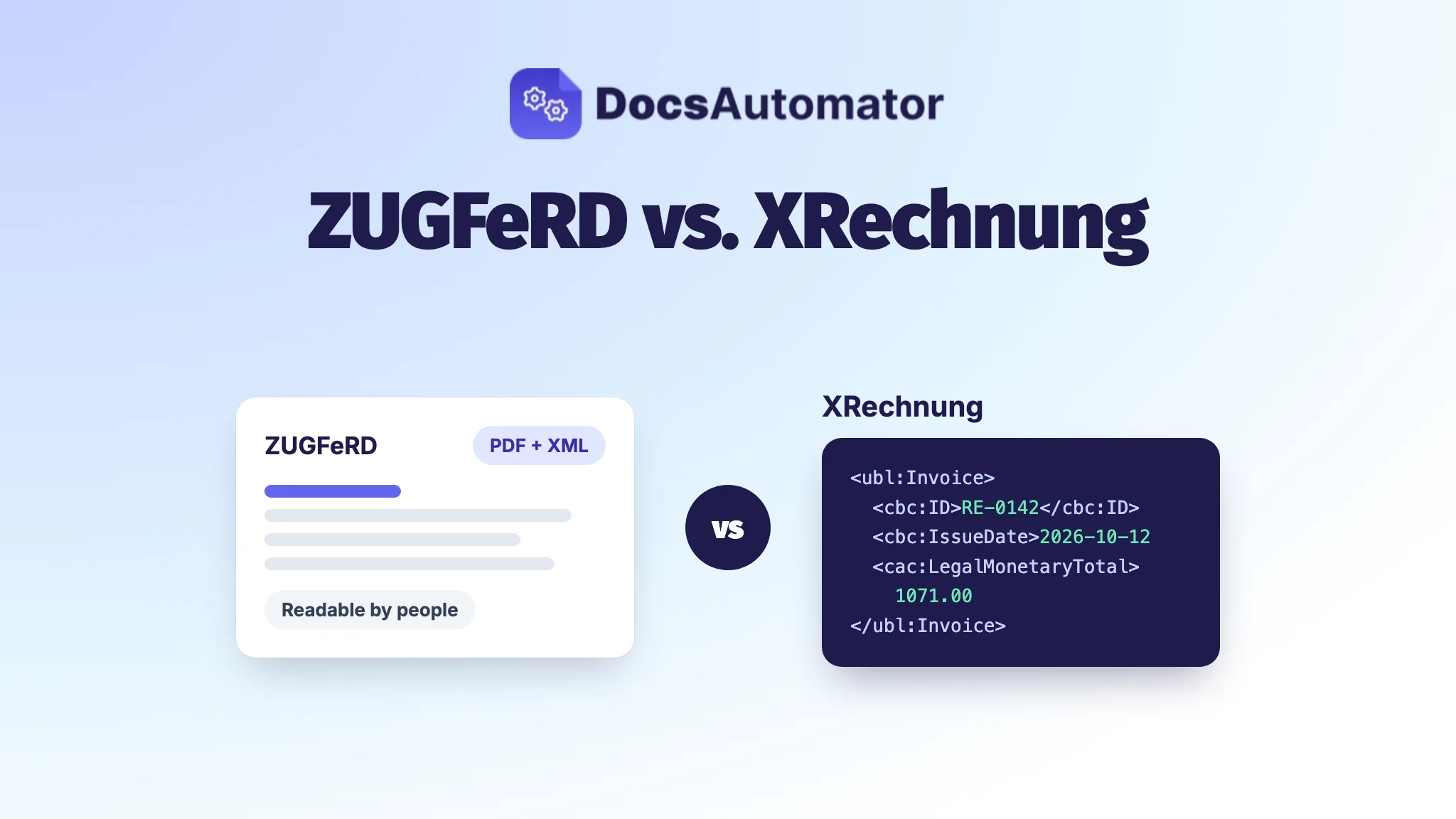
ZUGFeRD and XRechnung are both valid e-invoice formats in Germany. The difference is the file: a ZUGFeRD invoice is a PDF that people can read, with the invoice data embedded inside as XML. An XRechnung is only XML, so people need a viewer to read it. For invoices to businesses, either works; for public sector buyers, XRechnung is usually the one they ask for.
If you send invoices to other German businesses, you have to send e-invoices from 2027 or 2028, depending on your turnover. That brings up the question almost everyone asks first: ZUGFeRD or XRechnung? This guide explains the difference in plain terms, compares both formats side by side, and helps you pick the right one for each customer.
What is ZUGFeRD?
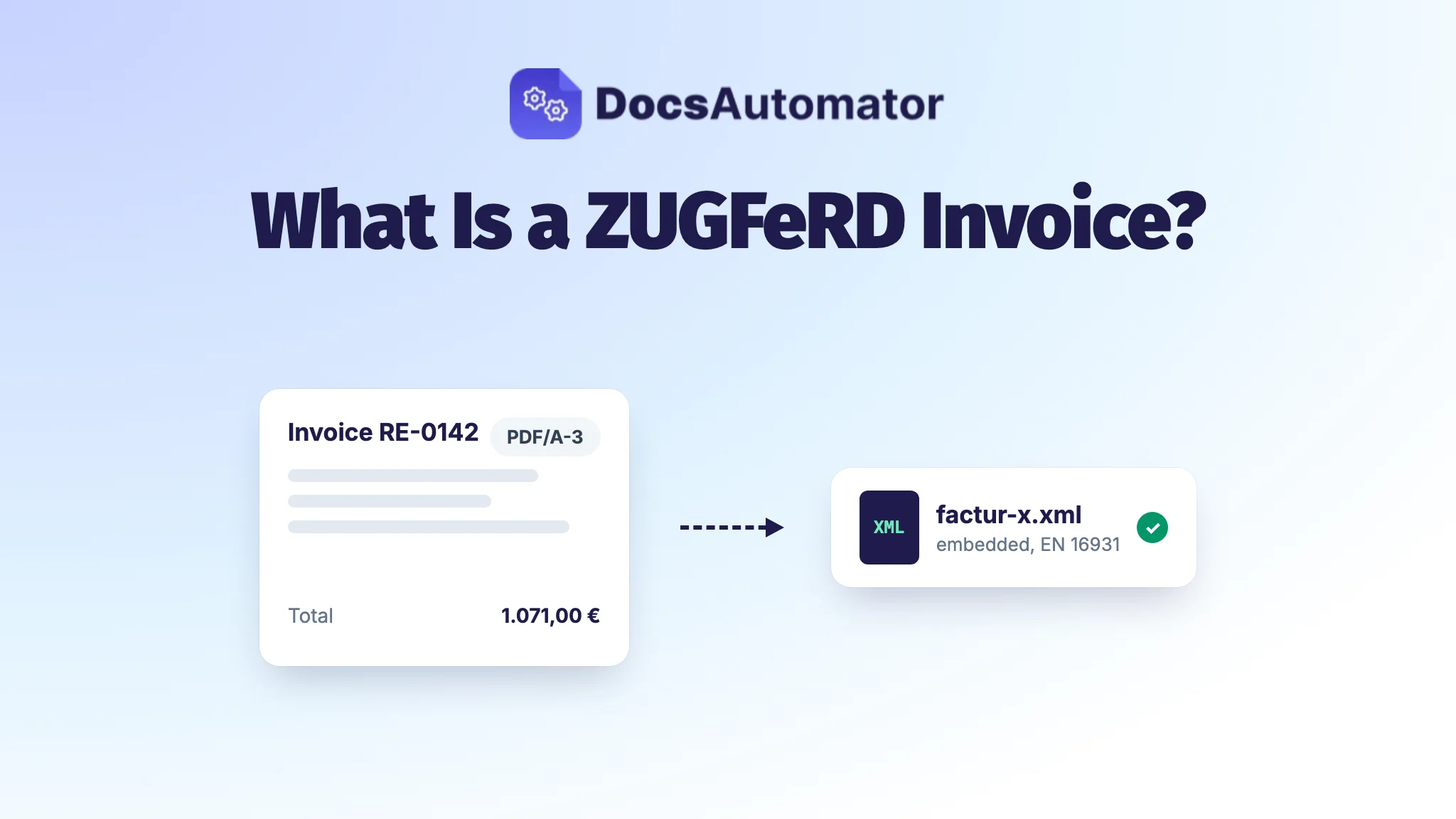
ZUGFeRD is a hybrid invoice format from the German Forum elektronische Rechnung Deutschland (FeRD). One ZUGFeRD file is a PDF in the archive format PDF/A-3 with an XML file embedded in it. The PDF shows the invoice the way your customer is used to seeing it, with your logo and layout. The embedded XML holds the same data in a structure that accounting software reads automatically. ZUGFeRD is technically the same format as the French Factur-X, and both are maintained together. The current version is ZUGFeRD 2.5.2 (Factur-X 1.09.2), in effect since September 1, 2026.
We explain the format in more detail in What is a ZUGFeRD invoice?
What is XRechnung?
XRechnung is the German standard for e-invoices, maintained by KoSIT, the coordinating office for IT standards of the German federal states. It is a national implementation of the European standard EN 16931 and consists of a single XML file, either in the syntax UBL or UN/CEFACT CII. There is no PDF view built in: to read an XRechnung, you open it in a viewer. The current version is XRechnung 3.0 (bundle 3.0.2 from August 2026). A version 4.0 is expected in spring 2027.
UBL or CII? For you as a sender, the syntax rarely matters: both carry the same EN 16931 data, and XRechnung allows either one. ZUGFeRD always uses CII, so an XRechnung in CII and a ZUGFeRD file share the same XML structure. That is why one set of invoice data can become either format.
XRechnung has been mandatory for suppliers of the German federal government since November 27, 2020. Those invoices carry a Leitweg-ID, an address that routes the invoice to the right public office.
The difference between ZUGFeRD and XRechnung
Both formats carry the same kind of data: invoice number, date, seller and buyer, line items, VAT and totals, structured according to EN 16931. They differ in the wrapper around that data.
- ZUGFeRD is a PDF with XML inside. One file serves both people and software. Your customer can open it in any PDF reader, and their accounting software reads the XML.
- XRechnung is XML only. It is made for software. A person opening the file sees code unless they use a viewer.
One detail matters for both: the XML is the invoice. In a ZUGFeRD file, the structured XML part is the leading part. If the XML and the PDF view ever disagree, the XML counts, according to the German Federal Ministry of Finance (BMF) in its letter of October 15, 2025.
ZUGFeRD vs. XRechnung at a glance
| ZUGFeRD | XRechnung | |
|---|---|---|
| File | PDF/A-3 with embedded XML | XML file only |
| Readable by people | Yes, in any PDF reader | Only with a viewer |
| XML syntax | UN/CEFACT CII | UBL or UN/CEFACT CII |
| Maintained by | FeRD (with FNFE-MPE in France as Factur-X) | KoSIT |
| Typical use | Invoices to businesses (B2B) | Public sector (B2G), and businesses that ask for it |
| Leitweg-ID | Only if the buyer asks for a reference | Required by public sector buyers (buyer reference, BT-10) |
| Current version | 2.5.2 (since September 2026) | 3.0 (bundle 3.0.2); 4.0 expected 2027 |
| Counts as an e-invoice | From version 2.0.1, profiles BASIC, EN 16931, EXTENDED and XRECHNUNG; not MINIMUM or BASIC WL | Yes |
Which format should you choose?
For VAT purposes, both count as e-invoices. German law requires an invoice in a structured electronic format that follows EN 16931 (§ 14 UStG), and both ZUGFeRD and XRechnung do. So the choice is mostly practical: what can your customer's software read, and how do they work?
- Public sector buyers: send XRechnung. Federal, state and many municipal offices expect it, usually through their invoice portals or Peppol, with a Leitweg-ID.
- Businesses that still read invoices by eye: ZUGFeRD is the easy choice. The person who approves the invoice sees a normal PDF, and the accounting software reads the XML.
- Businesses that ask for XRechnung: send XRechnung. Some companies process every incoming invoice automatically and prefer pure XML.
- Not sure? Ask your customer what their accounting software reads. Many accounting programs read both. Our e-invoicing overview covers the deadlines and formats in one place.
A quick example: Muster GmbH invoices a hardware store chain and a city administration. The hardware store gets a ZUGFeRD invoice, RE-2026-0142 for €1,071.00, which its bookkeeper opens like any PDF. The city gets the same invoice as XRechnung with its Leitweg-ID, uploaded to the city's invoice portal.
Can you switch or send both?
Yes. The format is a choice per invoice, not a lifelong decision. You can send ZUGFeRD to most customers and XRechnung to the few who ask for it. With an XRechnung, you can also send a PDF for people to read, but keep in mind that the XML is the invoice, not the PDF.
What you should avoid: sending the same invoice twice as two separate invoices. If a customer gets a ZUGFeRD and an XRechnung for the same delivery, make clear that it is one invoice in two forms, so nobody books or pays it twice.
Common mistakes with ZUGFeRD and XRechnung
- Using the ZUGFeRD profiles MINIMUM or BASIC WL. They do not contain all the data an invoice needs and do not count as e-invoices. Use EN 16931 (also called COMFORT) or a richer profile.
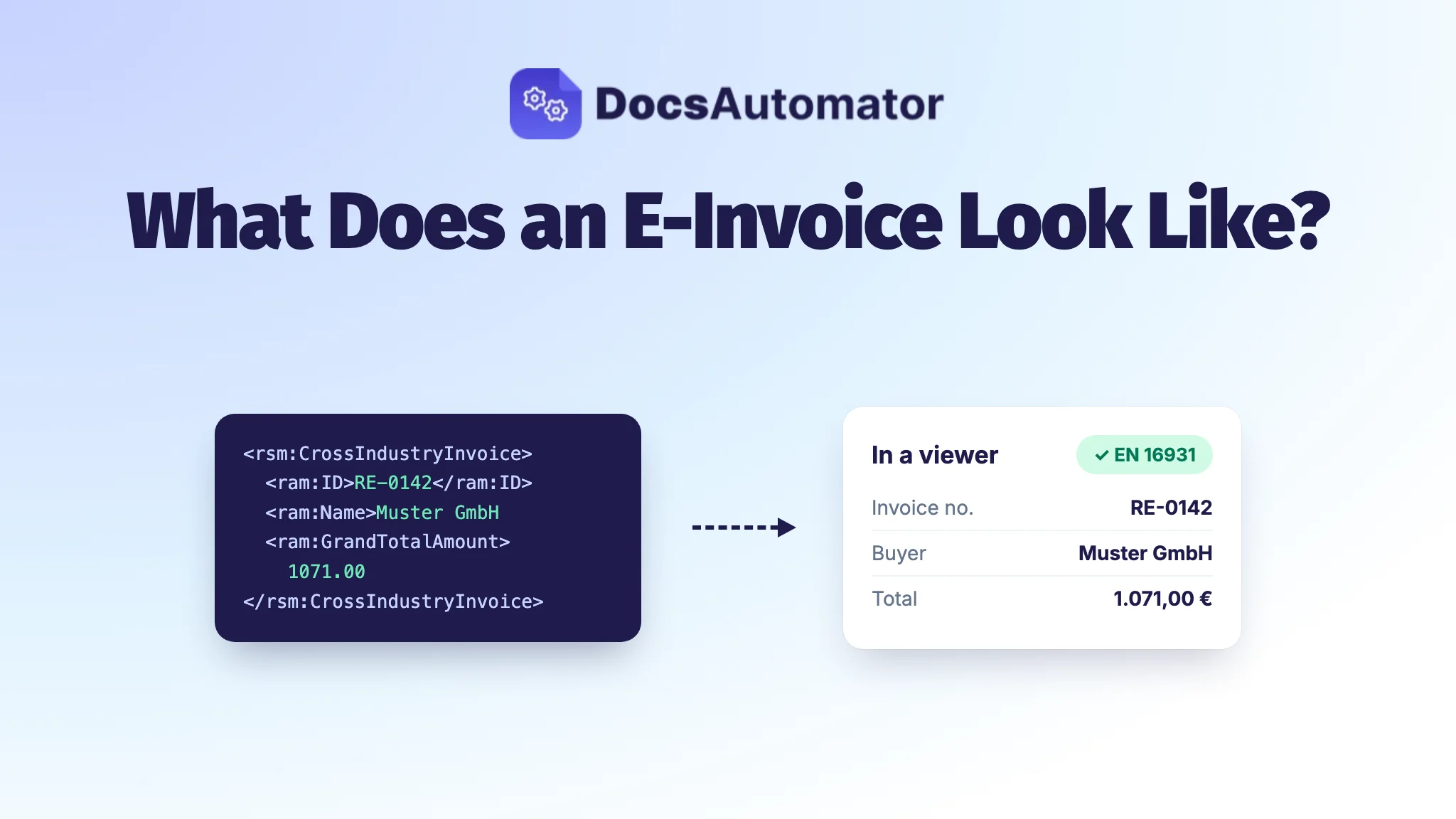
- Calling a plain PDF an e-invoice. A PDF sent by email is an "other invoice" under German VAT law, not an e-invoice. Only the structured XML makes it one. Our guide What does an e-invoice look like? shows the difference.
- Putting data only in the PDF. All mandatory details must be in the XML part. A reference to a PDF attachment is not enough.
- Forgetting the Leitweg-ID. Public sector buyers reject an XRechnung without it.
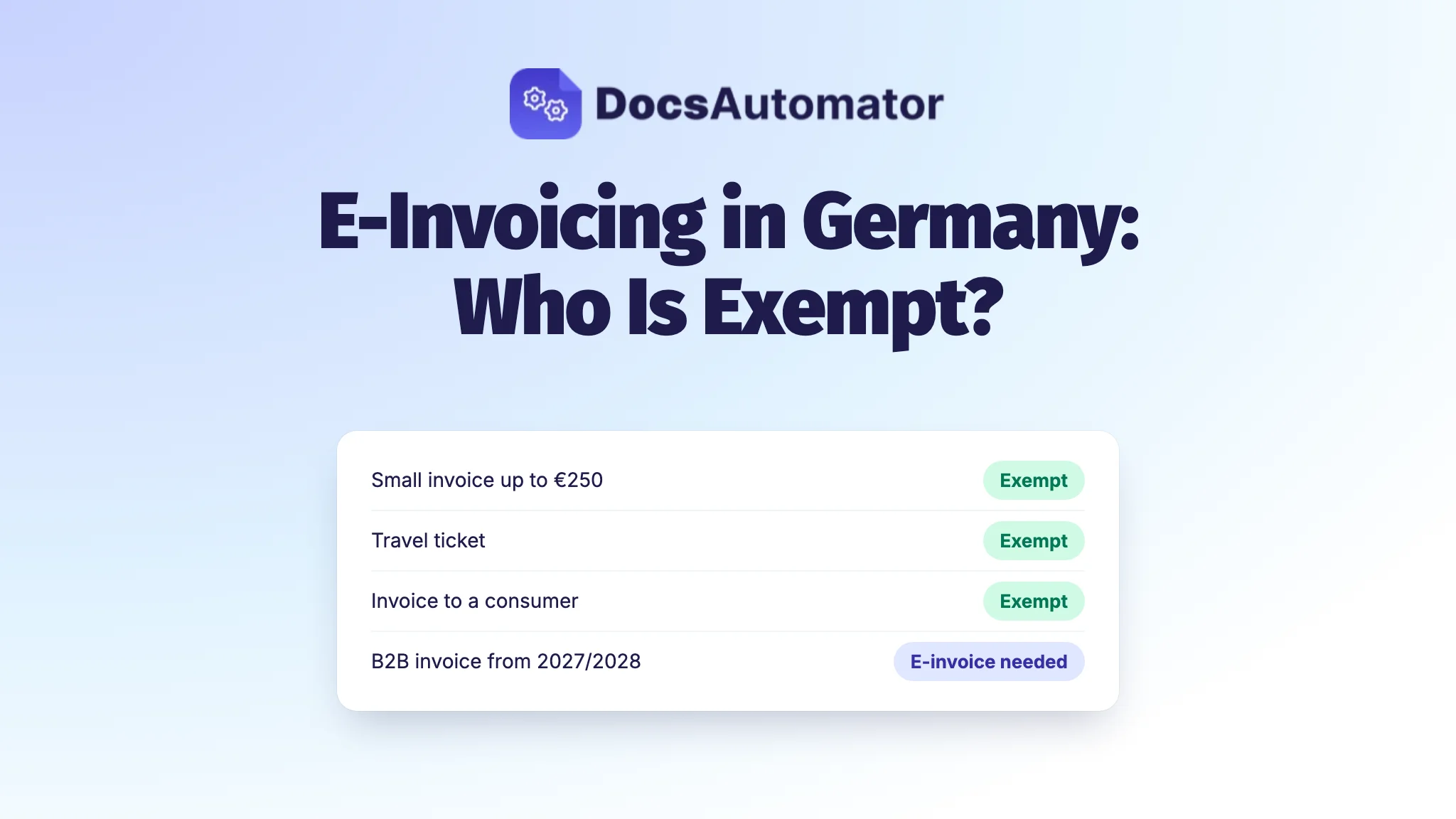
- Thinking every business must use e-invoices. Some invoices are exempt, for example small invoices up to €250 gross. See E-invoicing in Germany: who is exempt?
This guide explains the rules as of October 2026. It is not tax advice; for your own case, ask your tax adviser.
Create ZUGFeRD or XRechnung with DocsAutomator
With DocsAutomator you pick the format per automation: ZUGFeRD (EN 16931 profile, as PDF/A-3) or XRechnung 3.0. Both come from the same Google Docs or Word template and the same data, for example from Airtable, Google Sheets, Make, Zapier or your AI assistant. XRechnung is checked with the KoSIT validator, ZUGFeRD with Mustang, so every e-invoice is checked against EN 16931 before it goes out.
See how it works on our e-invoicing page, or send e-invoices from your own software through the e-invoicing API.
Frequently asked questions
Is ZUGFeRD the same as XRechnung?
No. ZUGFeRD is a PDF with the invoice data embedded as XML, so people and software can read it. XRechnung is an XML file only. Both are valid e-invoice formats under EN 16931.
Do I need XRechnung for invoices to businesses?
No. For invoices to other businesses in Germany, ZUGFeRD (from version 2.0.1, profile BASIC or higher) and XRechnung both count as e-invoices. Use XRechnung when your customer asks for it.
Which format do public authorities need?
Public sector buyers usually require XRechnung with a Leitweg-ID, sent through their invoice portal or Peppol. Federal suppliers have had to use it since November 27, 2020.
Is ZUGFeRD the same as Factur-X?
Yes. ZUGFeRD and the French Factur-X are technically the same format and are maintained together. ZUGFeRD 2.5.2 corresponds to Factur-X 1.09.2.
Which part of a ZUGFeRD invoice counts, the PDF or the XML?
The XML. It is the leading part of the invoice. If the XML and the PDF view differ, the XML counts.