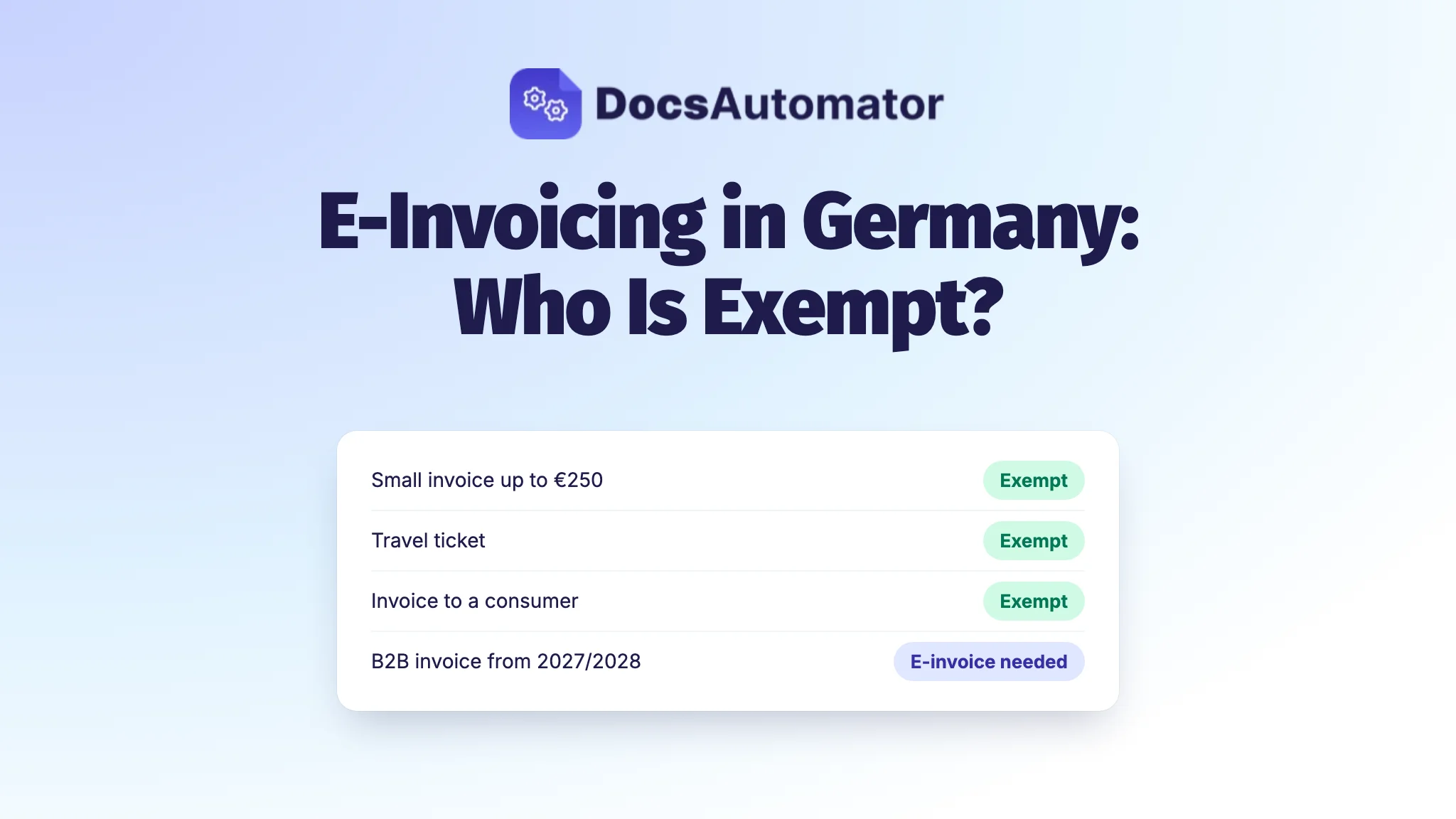
Germany's e-invoicing mandate has a few clear exemptions. You may keep sending paper or PDF invoices for small invoices up to €250 gross, for travel tickets and as a small business under the Kleinunternehmer rule. There is no e-invoice obligation at all for tax-exempt supplies under § 4 No. 8 to 29 UStG, for invoices to consumers and when you or your customer is not established in Germany.
Everything else between two businesses in Germany needs an e-invoice: from 2027 if your turnover was above €800,000 the year before, from 2028 for everyone. And one thing has no exemption: every business must be able to receive e-invoices since 1 January 2025.
Who must send e-invoices, and when
The mandate comes from § 14 and § 27 (38) of the German VAT Act (UStG). It covers invoices between businesses established in Germany (B2B). The dates:
- Since 1 January 2025: every business in Germany must be able to receive e-invoices. An ordinary email inbox is enough. A customer who can't open them has no right to get a paper or PDF version instead.
- 2025 and 2026: paper is still allowed; PDF and other non-standard formats with the recipient's consent.
- 2027: paper or PDF only if your total turnover (Gesamtumsatz under § 19 (2) UStG) in 2026 was €800,000 or less. Above that, you send e-invoices from 1 January 2027. EDI invoices that don't follow EN 16931 stay allowed with consent until the end of 2027, whatever your turnover.
- From 1 January 2028: e-invoices for all domestic B2B invoices.
An e-invoice is a structured file under the European standard EN 16931, such as XRechnung or ZUGFeRD. A PDF on its own, even sent by email, is not an e-invoice. The tax office calls it a "sonstige Rechnung", an "other invoice". The exemptions below say when that other invoice is still fine.
Exemptions: when paper or PDF stays allowed
Three kinds of invoice may always be sent as paper or PDF, even after 2028. The legal basis is the German VAT implementing ordinance (UStDV).
Small invoices up to €250 (§ 33 UStDV)
A Kleinbetragsrechnung is an invoice whose gross total is €250 or less. Think of a receipt for office supplies or a short repair. Its gross total counts, VAT included: a €230 net invoice with 19% VAT is €273.70 gross, so it is not a small invoice and needs to be an e-invoice once the mandate applies to you.
Travel tickets (§ 34 UStDV)
Fahrausweise, tickets for passenger transport such as a train or bus ticket, count as invoices and are exempt. The rail company may keep issuing them as it does today.
Small businesses under the Kleinunternehmer rule (§ 34a UStDV)
If you use the Kleinunternehmer scheme of § 19 UStG and charge no VAT, your invoices are exempt from the e-invoice obligation. You may keep sending PDFs.
For all three cases the BMF letter of 15 October 2025 adds a detail: you may send an e-invoice anyway, and you don't need the recipient's consent for it.
No e-invoice obligation at all
Some invoices are outside the mandate from the start, because § 14 (2) UStG only requires e-invoices for taxable supplies between domestic businesses:
- Tax-exempt supplies under § 4 No. 8 to 29 UStG. These include most financial and insurance services, residential rent, medical treatment and many educational services. A landlord renting out flats tax-free doesn't have to send rent invoices as e-invoices.
- Invoices to consumers (B2C). A private customer never needs an e-invoice.
- Cross-border invoices. If you or your customer is not established in Germany, the German mandate does not apply.
Here the consent rule is the other way round: you may send an e-invoice only if the recipient agrees. A consumer can't be made to deal with an XML file.
Overview: which invoices are exempt
| Case | E-invoice required? | Legal basis |
|---|---|---|
| Invoice up to €250 gross | No, paper or PDF allowed. E-invoice possible without consent. | § 33 UStDV |
| Travel ticket | No, paper or PDF allowed. E-invoice possible without consent. | § 34 UStDV |
| Invoice from a Kleinunternehmer | No, paper or PDF allowed. E-invoice possible without consent. | § 34a UStDV, § 19 UStG |
| Tax-exempt supply (§ 4 No. 8 to 29), e.g. residential rent | No. E-invoice only with consent. | § 14 (2) UStG |
| Invoice to a consumer | No. E-invoice only with consent. | § 14 (2) UStG |
| You or your customer not established in Germany | No. E-invoice only with consent. | § 14 (2) UStG |
| Reverse charge (§ 13b) between two German businesses | Yes | § 14 (2) UStG |
| Invoice with taxable and exempt items | Yes | BMF letter of 15 Oct 2025 |
| Any other B2B invoice in Germany | Yes, from 2027 or 2028 | § 14 (2), § 27 (38) UStG |
What is not an exemption
A few cases look like exceptions but aren't:
- Kleinunternehmer still have to receive. The exemption covers the invoices you send. When a supplier sends you an e-invoice, you need to be able to open and keep it. The same goes for farmers and foresters and for businesses with only tax-exempt sales, such as a landlord renting out flats.
- Reverse charge between German businesses. Invoices under § 13b UStG, common in construction, need to be e-invoices.
- Supplies under § 4 No. 1 to 7 UStG, such as an intra-EU supply to the branch of another German business in another EU country, are covered.
- Mixed invoices. If one invoice has taxable and exempt items, it needs to be an e-invoice.
- Voluntary VAT. If you opted to charge VAT on an otherwise exempt supply (§ 9 UStG), for example commercial rent, the mandate applies.
- Corrections. If the original invoice had to be an e-invoice, a correction to it has to be one too.
New in the BMF letter of October 2026
On 15 October 2026 the Federal Ministry of Finance published a third letter on e-invoicing. For exemptions it settles a few open questions:
- Down payments. Advance and progress invoices you issued before your own obligation started don't have to be e-invoices.
- Public fee notices (Bescheide under public law) may stay paper or PDF until 30 June 2030.
- Mixed customer bases. Suppliers with many business and private customers, such as energy companies, only need to check whether a customer is a business when the contract starts or changes.
- No fine. Sending a PDF where an e-invoice was required is not an administrative offence under § 26a UStG.
That last point doesn't make the PDF harmless. Once the transition ends, your customer may lose the input VAT deduction for an invoice that should have been an e-invoice. Most customers will ask for the right format long before that.
This guide explains the rules as of October 2026. It is not tax advice; for your own case, ask your tax adviser.
Create the invoices that need it with DocsAutomator
For the invoices that aren't exempt, DocsAutomator e-invoicing turns your existing process into e-invoices. You keep your own Google Docs, Word or PDF template and the data you already have in Airtable, Google Sheets, Notion, Make, Zapier or n8n. You pick ZUGFeRD or XRechnung per automation, and every e-invoice is checked against EN 16931 before it goes out: XRechnung with the KoSIT validator, ZUGFeRD with Mustang.
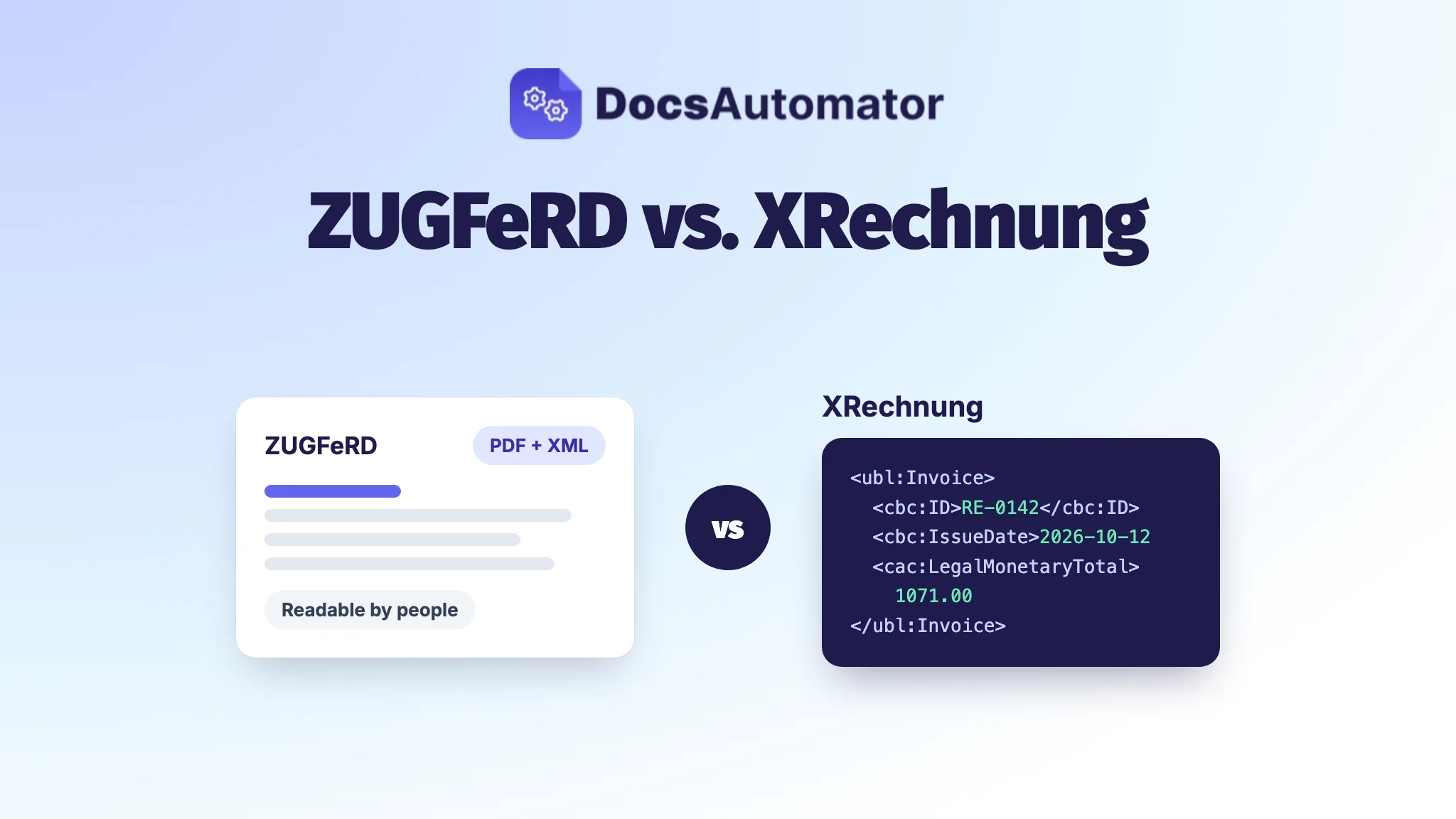
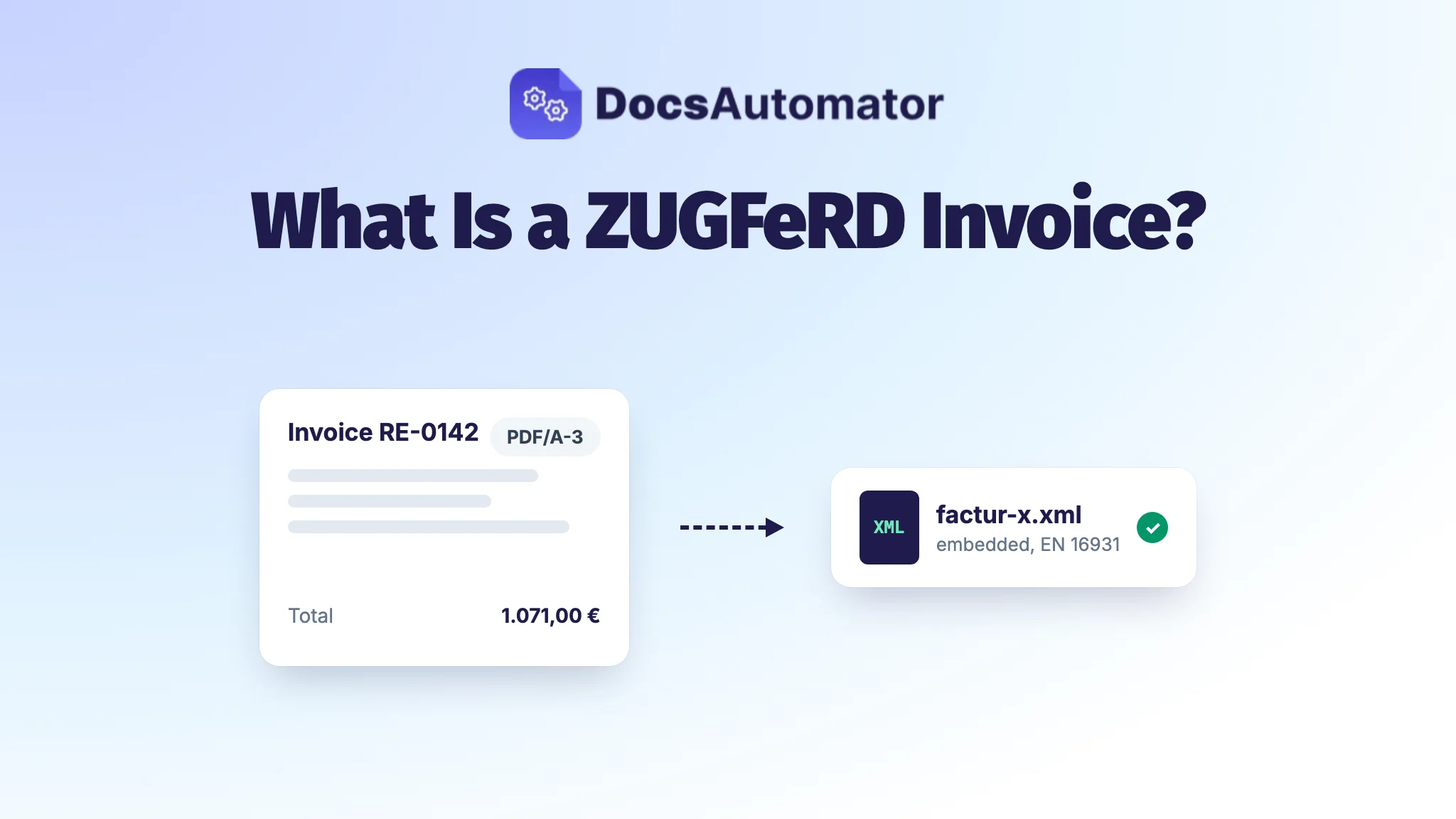
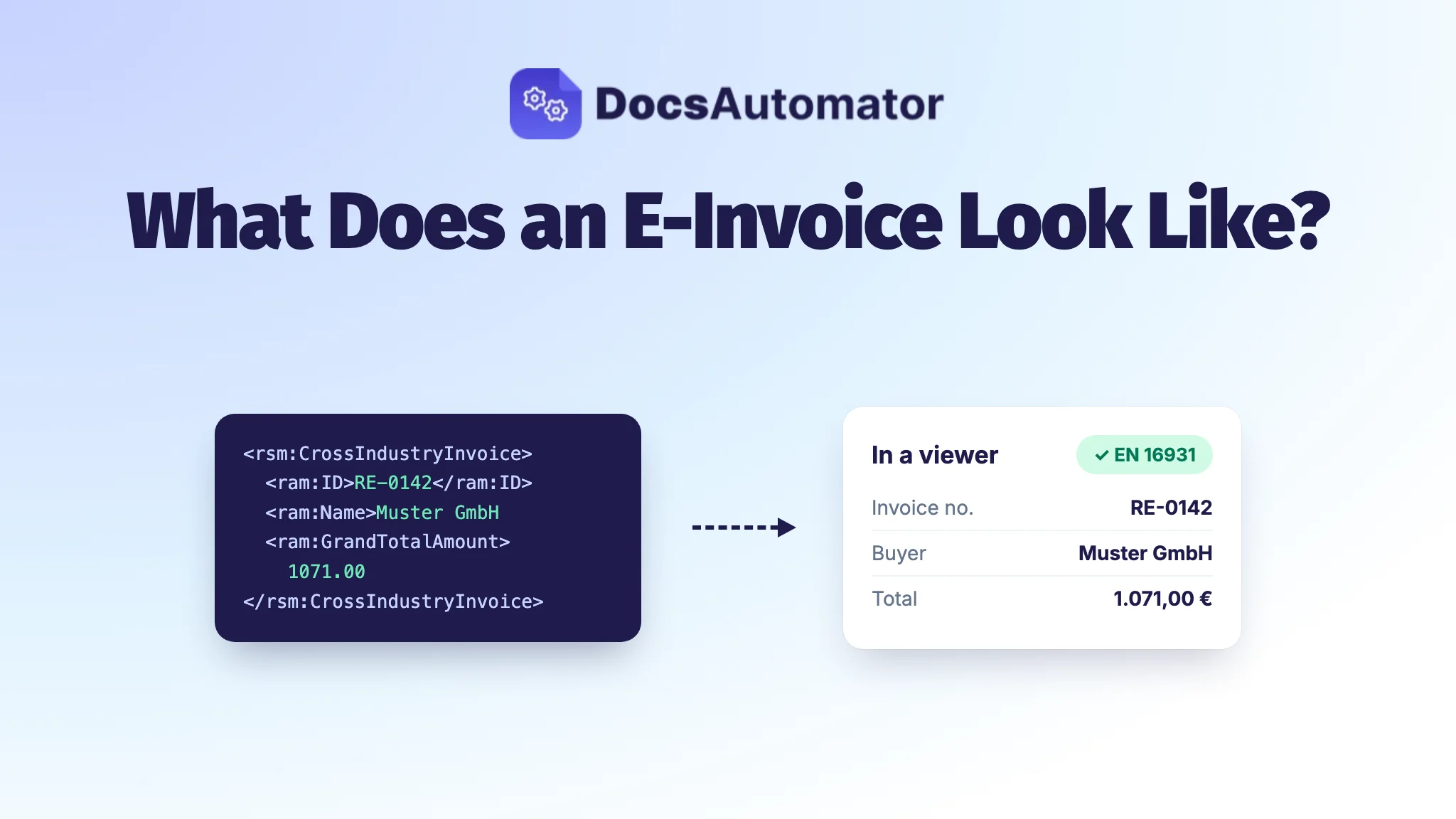
Building it into your own software? The e-invoicing API takes JSON and returns the checked e-invoice. Not sure which format your customers want? Read what a ZUGFeRD invoice is and what an e-invoice looks like, or see how e-invoicing works in DocsAutomator.
Frequently asked questions
Are small businesses exempt from the e-invoice mandate?
Small businesses under the Kleinunternehmer rule (§ 19 UStG) don't have to send e-invoices; § 34a UStDV allows paper or PDF. They still have to be able to receive e-invoices since 1 January 2025.
Is a €250 invoice exempt from e-invoicing?
Yes. An invoice with a gross total of €250 or less is a Kleinbetragsrechnung under § 33 UStDV and may stay paper or PDF. You may still send it as an e-invoice without asking the recipient.
Do I need e-invoices for private customers?
No. The mandate only covers invoices between businesses established in Germany. You may send a private customer an e-invoice only if they agree.
Is there a fine for sending a PDF instead of an e-invoice?
No. According to the BMF letter of 15 October 2026, it is not an administrative offence under § 26a UStG. Your customer may lose the input VAT deduction once the transition ends, though.
Does reverse charge count as an exemption?
No. Invoices under § 13b UStG between two businesses in Germany are covered by the mandate and need to be e-invoices from 2027 or 2028.