A ZUGFeRD invoice is a PDF that carries its own invoice data. You see a normal invoice page; inside the file sits a structured XML version of the same invoice that accounting software can read without anyone typing it in. From ZUGFeRD 2.0.1 on, and in every profile except MINIMUM and BASIC WL, a ZUGFeRD file counts as an e-invoice under German VAT law.
That makes ZUGFeRD the format most German businesses meet first when the e-invoicing rules reach them. Every business in Germany has had to be able to receive e-invoices since January 1, 2025. Businesses with more than €800,000 in turnover in the previous year have to send them from January 1, 2027, and almost everyone else from January 1, 2028 (the deadlines at a glance are on our e-invoicing page). This guide explains what is inside a ZUGFeRD file, which versions and profiles count, and how to make one.
What is a ZUGFeRD invoice?
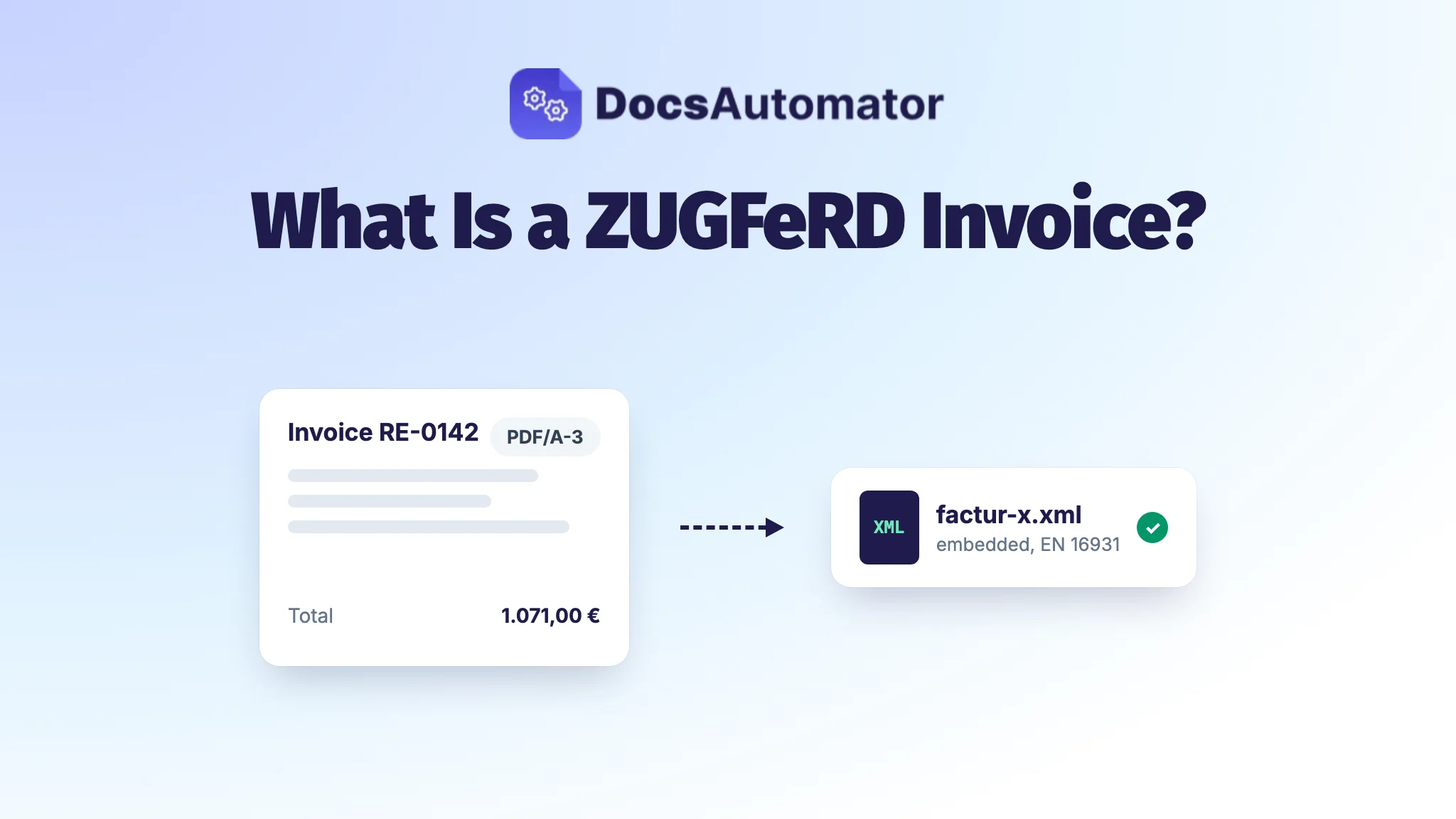
ZUGFeRD is a hybrid invoice format. One file holds two things:
- A PDF/A-3 document that people read. It looks like the invoice you send today: your logo, the address block, the line items, the total. PDF/A-3 is the archiving variant of PDF that allows other files to be attached inside it.
- An XML file embedded in that PDF, written in the UN/CEFACT Cross Industry Invoice (CII) syntax. It holds the same invoice as structured data: invoice number, date, seller, buyer, VAT ID, line items, tax rates and totals, each in a defined field.
Your customer can open the PDF in any PDF reader. Their accounting software reads the XML and books the invoice without manual entry. That is the whole idea: one file for people and machines.
The name stands for "Zentraler User Guide des Forums elektronische Rechnung Deutschland". The format is published by FeRD, the German e-invoicing forum, together with its French partner. The French version is called Factur-X, and since ZUGFeRD 2.1 the two are technically the same format with two names.
Is a ZUGFeRD invoice an e-invoice?
Usually yes, but not always. German VAT law (§ 14 UStG) defines an e-invoice as an invoice in a structured electronic format that is issued, sent and received electronically and follows the European standard EN 16931. A plain PDF, a scan or a Word file is not an e-invoice; the law calls it an "other invoice".
In its letter of October 15, 2025, the Federal Ministry of Finance (BMF) says which ZUGFeRD files qualify: version 2.0.1 or later, in any profile except MINIMUM and BASIC WL. Those two profiles leave out data that EN 16931 requires, such as the line items.
Two more rules from the BMF matter in practice:
- The XML counts. If the PDF page and the XML say different things, the XML wins. The structured part is the invoice for tax purposes.
- All mandatory details belong in the XML. Writing the delivery date or the VAT ID only on the PDF page is not enough. Extra material such as timesheets may travel as an attachment.
ZUGFeRD profiles: which ones count as an e-invoice
A profile decides how much data the XML carries. The PDF page can look identical in every profile; the difference is inside.
| Profile | What the XML contains | Counts as an e-invoice? |
|---|---|---|
| MINIMUM | Header data only, such as invoice number, date and total | No |
| BASIC WL | Header and totals, no line items | No |
| BASIC | Line items, a subset of EN 16931 | Yes |
| EN 16931 (formerly COMFORT) | The full core standard | Yes |
| EXTENDED | EN 16931 plus extra fields for industry needs | Yes |
| XRECHNUNG | The rules of XRechnung, written in CII | Yes |
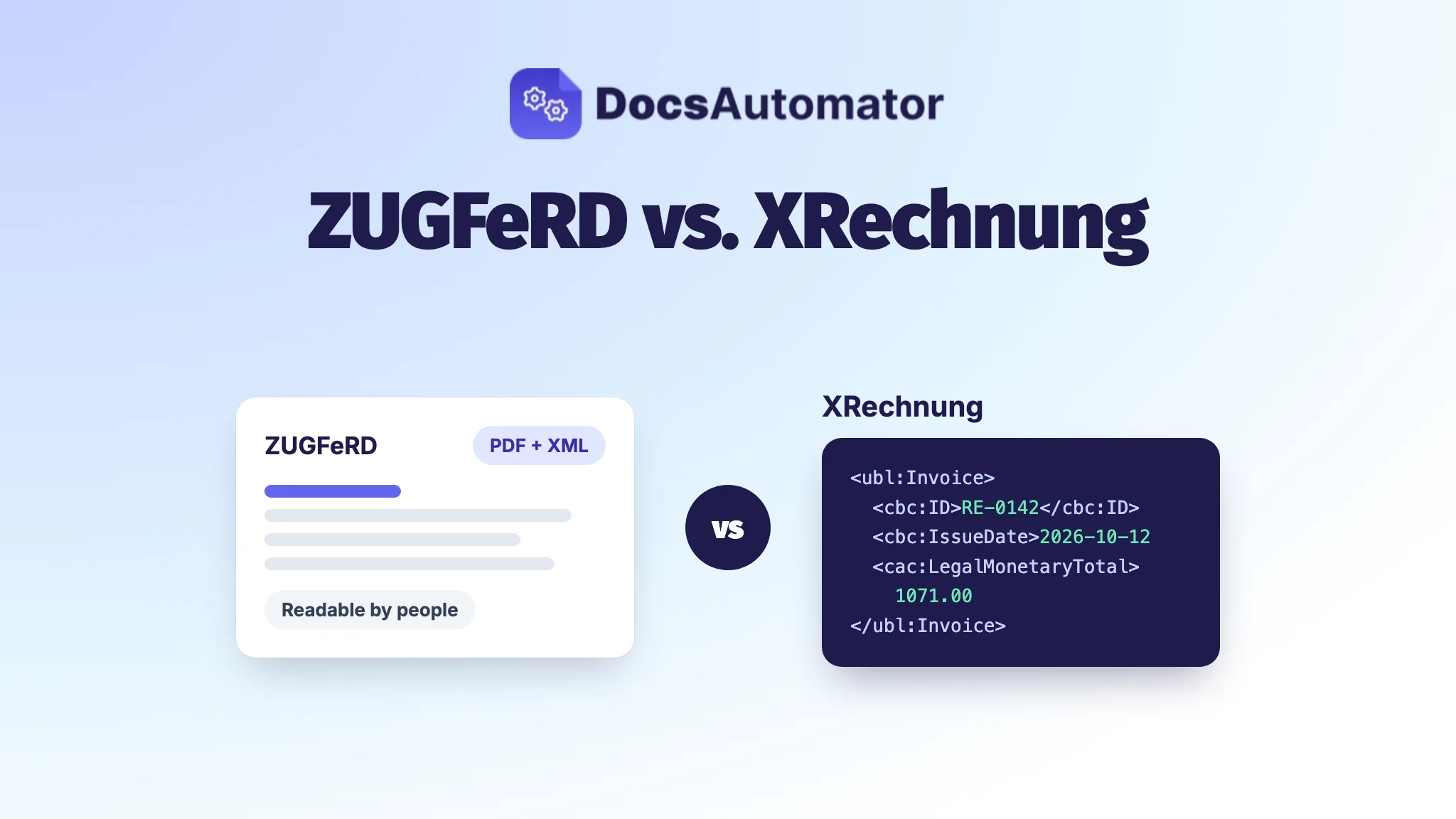
For most invoices between businesses, EN 16931 is the sensible choice. It covers everything the standard asks for and every receiving system has to understand it. EXTENDED is for industries that need more fields, such as construction or energy. If your customer is a public authority, ask whether they accept ZUGFeRD at all or want an XRechnung; our guide ZUGFeRD vs. XRechnung compares the two.
ZUGFeRD versions: what is current
ZUGFeRD 1.0 appeared in 2014, but for German e-invoicing only version 2.0.1 and later count. FeRD has kept the format moving since:
- 2.4 (Factur-X 1.08), in effect since January 15, 2026.
- 2.5 (Factur-X 1.09), published June 10, 2026.
- 2.5.2 (Factur-X 1.09.2), in effect since September 1, 2026. This is the current version; it corrects the EXTENDED profile.
Newer versions stay compatible with the EN 16931 core, so an invoice made with an earlier 2.x version is still valid. What matters for your customer is that the XML is correct and complete, not that you use the very latest release.
How to tell whether a PDF is a ZUGFeRD invoice
You cannot tell from the page alone. A ZUGFeRD invoice and a plain PDF invoice can look exactly the same. Two quick checks:
- Open the attachments panel in a PDF reader such as Adobe Acrobat Reader (the paper clip icon). A ZUGFeRD file shows an XML attachment there. No attachment means it is a plain PDF.
- Run it through a validator. A validator checks the XML against EN 16931 and the ZUGFeRD rules and tells you the profile and any errors. That is also how you know whether the file is a real e-invoice or only looks like one.
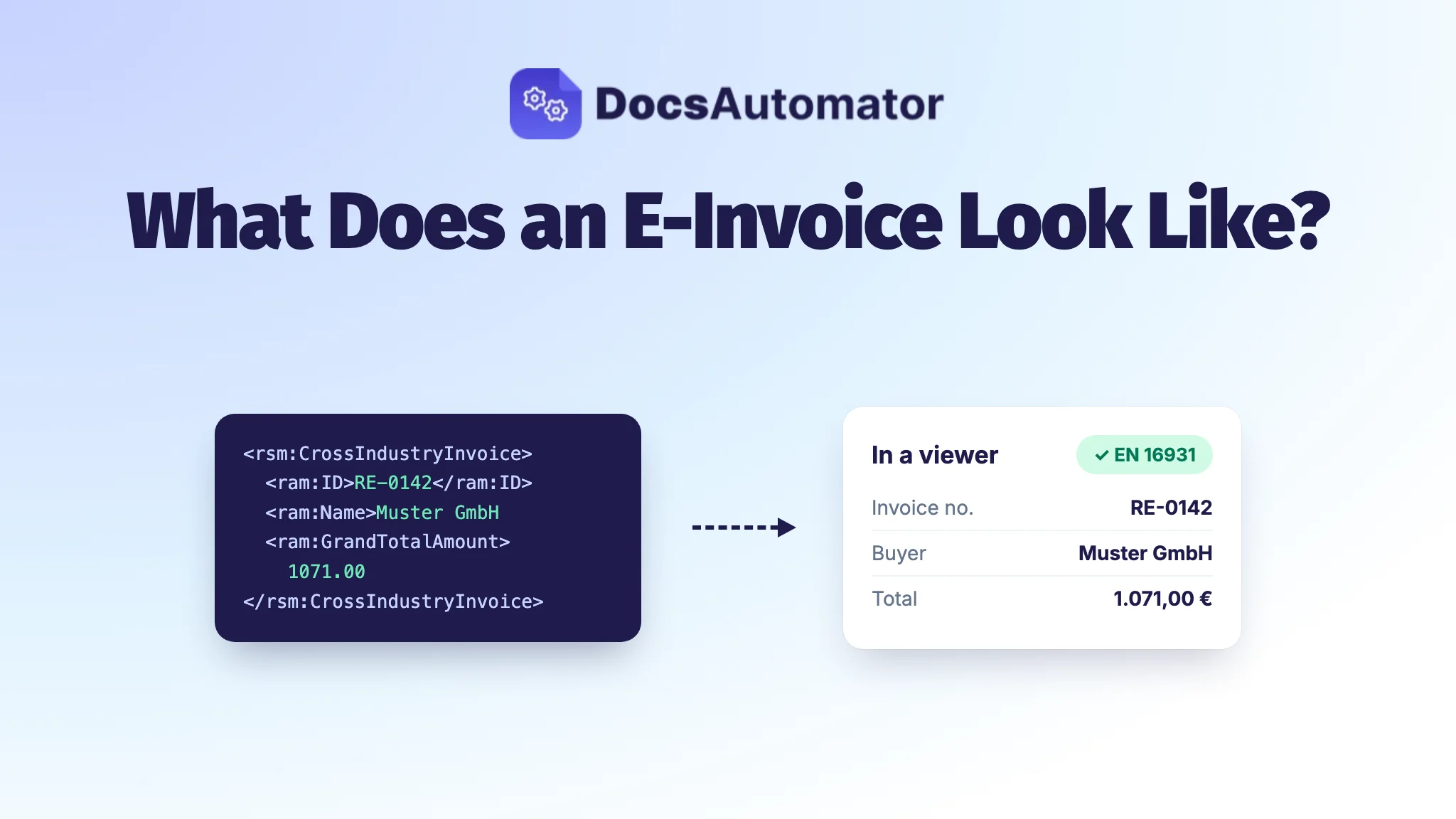
If you want to see what the XML itself looks like and how people read it, our guide What does an e-invoice look like? walks through the fields.
How to create a ZUGFeRD invoice
A ZUGFeRD invoice has to be made by software that writes the XML. Printing to PDF, scanning or saving a Word file as PDF never creates one, because the structured data is missing. Typical ways in:
- Accounting or invoicing software that has a ZUGFeRD export.
- A free online generator for the odd invoice, where you type in the data by hand.
- Software that builds the invoice from your own data, such as a spreadsheet, a database or an order, and writes PDF and XML together.
Whatever you use, check three things: the profile (EN 16931 for most business invoices), that every mandatory detail is in the XML and not only on the page, and that the file passes a validator. A format error in the XML means the file is not an e-invoice at all.
Receiving and archiving ZUGFeRD invoices
Since 2025 you must be able to receive e-invoices, and an ordinary email inbox is enough for that. When a ZUGFeRD invoice arrives, keep the whole file including the embedded XML, unchanged. Since 2025 the retention period for invoices is eight years (§ 14b UStG). A printout or a flattened copy of the page does not replace the original file.
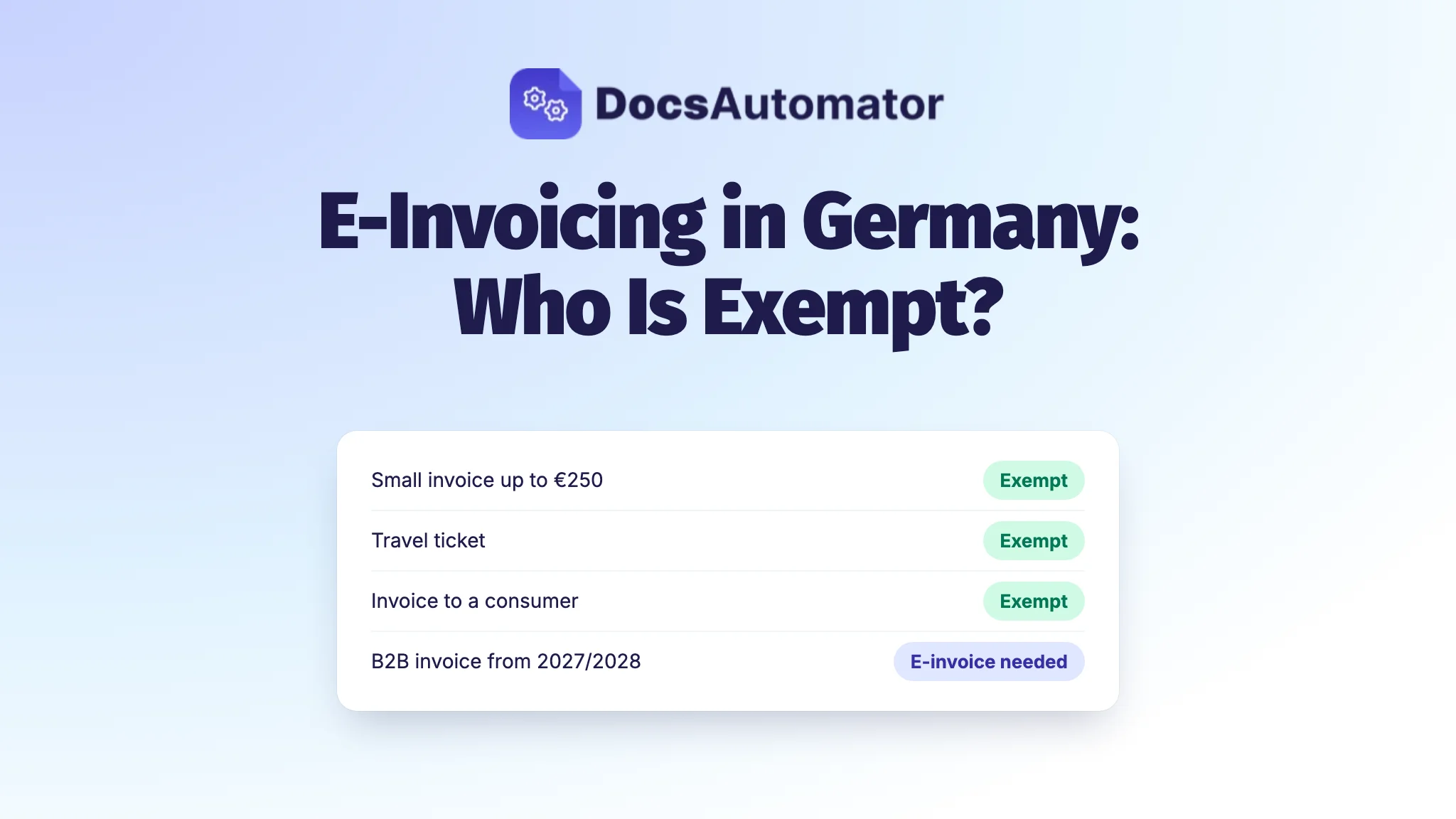
Are you exempt from sending e-invoices, for example as a small business under the Kleinunternehmer rule? The answer and the other exemptions are in our guide E-invoicing in Germany: who is exempt?
This guide explains the rules as of October 2026. It is not tax advice; for your own case, ask your tax adviser.
Create ZUGFeRD invoices with DocsAutomator
DocsAutomator turns your own invoice template from Google Docs or Word into the PDF and embeds the invoice data as XML, in the EN 16931 profile (also known as Factur-X) as PDF/A-3. The data comes from where your invoices already live: Airtable, Google Sheets, Notion, Make, Zapier, n8n, the API or an AI agent such as Claude or ChatGPT.
Before an invoice goes out, DocsAutomator checks the ZUGFeRD file with Mustang and recalculates lines, tax and totals. If a check fails, nothing is created and nothing is sent. You can set everything up and test it for free; see e-invoicing with DocsAutomator for how it works, or the e-invoice API if you send invoices from your own app.
Frequently asked questions
Is ZUGFeRD the same as Factur-X?
Yes. Since ZUGFeRD 2.1 the German ZUGFeRD and the French Factur-X are technically the same format, maintained together. A Factur-X invoice in a qualifying profile is also accepted as an e-invoice in Germany.
Is a ZUGFeRD invoice in the MINIMUM profile enough from 2027?
No. The BMF does not accept the MINIMUM and BASIC WL profiles as e-invoices because they lack data that EN 16931 requires. Use BASIC, EN 16931, EXTENDED or XRECHNUNG.
What if the PDF page and the XML show different amounts?
The XML counts. The BMF treats the structured part as the invoice, so a mismatch is an error in the invoice and has to be corrected with a new e-invoice.
Can I turn an existing PDF invoice into a ZUGFeRD invoice?
Only with software that writes the matching XML and embeds it as PDF/A-3. Renaming, printing or scanning a PDF does not add the structured data, so the result stays a plain PDF.
How long do I have to keep ZUGFeRD invoices?
Eight years, in the original file including the embedded XML. A printout or an image of the page does not replace it.